Sobha Boulevard Master Plan - Layout, Road Hierarchy, Open Space and Plot Disposition
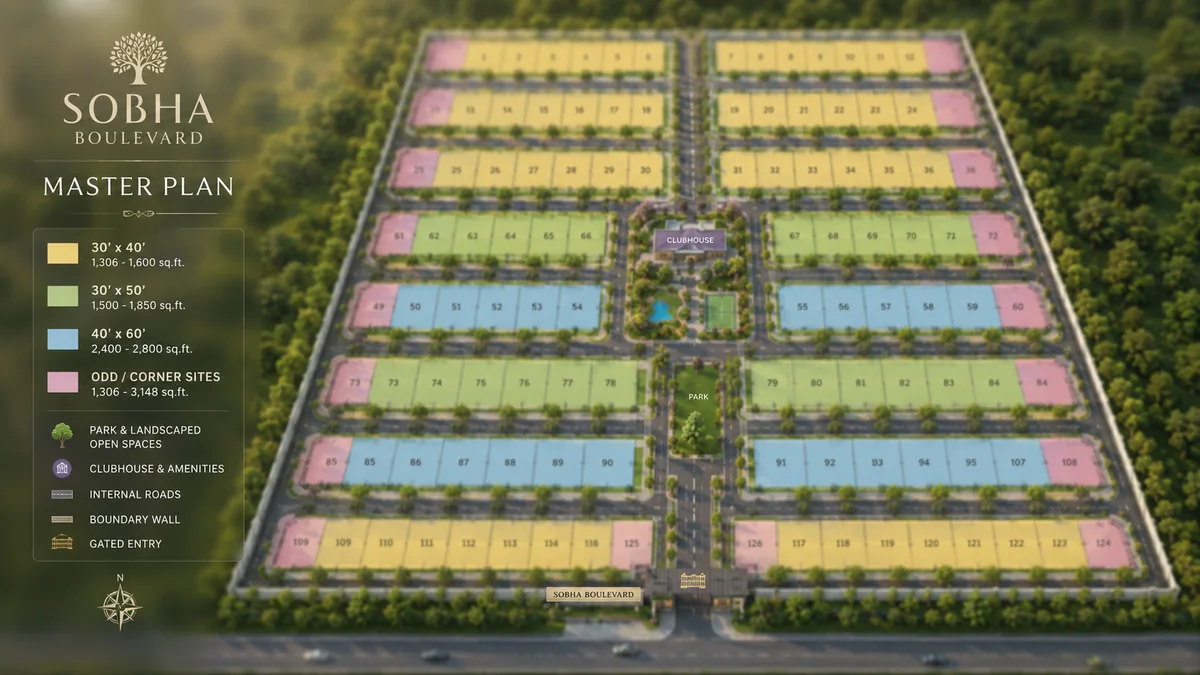
The Sobha Boulevard master plan is the blueprint for a single gated MUDA plotted community of 126 plots across 9 acres and 31.5 guntas at Belagola, Mysuru corridor. For a plotted development, the master plan matters more than any brochure image, because it determines everything a buyer cares about: how the plots are laid out, how wide and well-engineered the roads are, how much of the site is reserved as open space, where the civic amenities sit, and how each plot is oriented and positioned relative to the greens and the gated entry. This page reads the Sobha Boulevard master plan in detail - the road hierarchy, the plot distribution across the four formats, the open-space and civic-amenity provision, and how to use the plan to choose the right plot - so that a buyer understands the physical structure of the community before committing. For a developer-portfolio lens, SOBHA Hennur–Bagalur is useful because the brand context is shared even though the market, commute pattern, and buyer profile need their own checks.
The Layout at a Glance
Sobha Boulevard is planned as a single gated layout, entered through a controlled gateway, with an internal road network that connects every plot to the entry and to the community's open spaces. The parcel is irregular in shape - a characteristic of MUDA layouts assembled from surveyed village land - and the plan works with that geometry, using the road grid to subdivide the land efficiently into the 126 plots while reserving generous pockets for greens, a civic-amenity area and utility functions. The plan's colour legend distinguishes the four plot formats: 40'x60' (2,400 sq.ft), 30'x50' (1,500 sq.ft), 30'x40' (1,200 sq.ft) and the odd plots (1,306-3,148 sq.ft), so a buyer can see at a glance where each size sits within the community.
| Master-plan element | Provision |
|---|---|
| Total land area | 9 Acres, 31.5 Guntas (~9.79 acres) |
| Total plots | 126 |
| Plot formats | 40'x60', 30'x50', 30'x40', odd sites |
| Primary internal road | 30 metres wide |
| Secondary internal roads | 12 metres wide |
| Tertiary internal roads | 9 metres wide |
| Open space | Multiple parks & landscaped green pockets |
| Civic amenity | Reserved CA area within the layout |
| Access | Single gated entry |
| Approving authority | Mysuru Urban Development Authority (MUDA) |
The Road Hierarchy
The quality and width of the internal roads is one of the clearest markers of an organised plotted development, and it directly affects both daily living and resale value. Sobha Boulevard's master plan sets out a clear three-tier road hierarchy:
- The 30-metre primary spine - a wide main road that carries traffic into and through the layout, off which the internal roads branch. A 30-metre road is a generous primary artery for a plotted community of this size, giving the layout a sense of openness and easy circulation, and ensuring the community never feels cramped.
- The 12-metre secondary roads - the internal distributor roads that connect the primary spine to the residential clusters, wide enough for comfortable two-way movement and on-street convenience.
- The 9-metre tertiary roads - the access roads fronting individual plots, sized to serve the residential frontages while keeping the layout compact and walkable.
This graded hierarchy is exactly what distinguishes a Sobha-engineered layout from a loose revenue-site subdivision, where road widths are often minimal and inconsistent. Wider, properly-engineered roads mean better light and ventilation for the homes that front them, easier construction access, comfortable parking, and a more valuable, more liveable community - and they are built to Sobha's in-house standard, which is the same discipline the developer applies to its flagship apartment campuses.
Open Space and Civic Amenities
A gated plotted community lives or dies on its common areas, and the Sobha Boulevard master plan reserves meaningful land for open space and civic function rather than maximising saleable plots at the expense of liveability. The plan shows multiple parks and landscaped green pockets distributed through the layout, so that greenery is woven into the community rather than confined to a single corner, and a dedicated Civic Amenity (CA) area reserved for community facilities. These reserved spaces do several things: they give residents landscaped greens, walking and jogging paths and children's play areas from day one; they improve the environmental quality and micro-climate of the layout; and - crucially for an investor - they protect and enhance plot values, because plots fronting or near the greens command a premium and the whole community benefits from the amenity provision. Plots positioned around these open spaces are among the most sought-after in any plotted layout, and identifying them on the master plan is a key part of choosing a plot.
Plot Disposition Across the Four Formats
The 126 plots are distributed across the four formats, and the master plan shows where each size sits:
| Format | Dimensions | Plot area | No. of plots | Share |
|---|---|---|---|---|
| Type 1 | 40' x 60' | 2,400 sq.ft | 13 | ~10% |
| Type 2 | 30' x 50' | 1,500 sq.ft | 42 | ~33% |
| Type 3 | 30' x 40' | 1,200 sq.ft | 46 | ~37% |
| Odd sites | irregular | 1,306 - 3,148 sq.ft | 25 | ~20% |
The two standard mid-formats - the 1,200 sq.ft (30x40) and 1,500 sq.ft (30x50) - together account for around 70% of the layout (88 of the 126 plots), which is the right balance for a community of this kind: these are the most liquid, most in-demand sizes in the Mysuru market, and having them as the backbone of the layout keeps the community accessible and its plots easy to resell. The 2,400 sq.ft (40x60) plots, a smaller set of 13, sit as the premium format for buyers wanting a larger, villa-scale home, and the odd sites (up to 3,148 sq.ft) offer the largest single holdings for buyers who want the most land. This distribution is deliberate - a spread of sizes that serves a range of buyers while keeping the liquid mid-formats dominant.
How to Read the Master Plan When Choosing a Plot
The master plan is the single most useful tool for choosing a plot, and a buyer should use it to evaluate three things:
Position relative to the greens and amenities. Plots fronting or adjacent to the parks, open spaces and the civic-amenity area carry a premium and are the most sought-after - they offer a better outlook, more light and ventilation, and stronger resale appeal. Identify these on the plan first.
Corner plots and road frontage. Corner plots have road access on two sides, which gives more frontage, better light and cross-ventilation, more flexible home orientation and higher resale value. They typically carry a premium over the base rate. The plan shows which plots are corners and which front the wider roads.
Facing and orientation. The direction a plot faces affects how a home is positioned for morning light, cross-ventilation and Vaastu preference - considerations that matter to a large share of buyers and that influence resale appeal. The master plan and the plot-disposition drawing identify the facing of each plot, so a buyer can match their preference to the available inventory.
Because these factors materially affect both the home a buyer can build and the value of the asset, the master plan should be read alongside the current plot-availability list - which plots of which size, facing and position remain available. The plot options page explains the plot formats, corner and facing premiums and the plotted-ownership mechanics in full, and the pricing page sets out how the preferential-location charges for premium plots are applied on the cost sheet.
Infrastructure Built Into the Plan
Beyond the roads and open spaces, the master plan integrates the full plotted-community infrastructure stack, built into the layout so that every plot is delivered build-ready:
- Engineered internal roads (30 M / 12 M / 9 M hierarchy)
- Underground water supply lines and assured water provision
- Underground sewage / drainage network
- Electrical distribution and LED street lighting
- High-capacity storm-water drains
- Avenue and open-space landscaping
- Gated entry with secured perimeter
Because this infrastructure is planned and built as part of the layout - to MUDA sanction and to Sobha's in-house engineering standard - a buyer can commence home construction without waiting on civic agencies for primary connections. This "ready-to-build" delivery is the defining advantage of an organised Sobha plotted development over unplanned land, and it is what the master plan exists to deliver.
Obtaining the Master Plan
The full master plan, including the plot-disposition drawing that identifies each plot's size, facing, position and any corner or park-facing premium, is available on request. Because plot selection is best done against the actual, current availability - and because the best plots (corners, park-facing sites, preferred orientations and larger formats) are chosen first at the new-launch stage - a buyer should obtain the master plan and the availability list together. Use the enquiry form on this microsite to request the master plan, the plot-disposition drawing and current availability, and to arrange a site visit to Belagola; a Sobha representative will provide the detail and walk you through the layout.
Due-Diligence References
Cross-check with plot options and amenities on this site, then use the links below for independent verification.
Sobha Boulevard Master Plan - Frequently Asked Questions
How big is the Sobha Boulevard layout and how many plots does it have?
Sobha Boulevard is a single gated MUDA plotted community of 126 plots across 9 acres and 31.5 guntas (about 9.79 acres) at Belagola on the Mysuru corridor, with land reserved for parks, a civic-amenity area and utilities.
How wide are the internal roads?
The master plan sets out a three-tier road hierarchy: a 30-metre primary spine carrying traffic through the layout, 12-metre secondary distributor roads connecting the clusters, and 9-metre tertiary roads fronting individual plots.
How are the 126 plots distributed across the formats?
There are 13 plots of 40x60 (2,400 sq.ft), 42 of 30x50 (1,500 sq.ft), 46 of 30x40 (1,200 sq.ft) and 25 odd sites of 1,306 to 3,148 sq.ft. The two mid-formats make up around 70% of the layout, keeping it liquid and accessible.
What open space and civic amenities does the plan reserve?
The plan reserves multiple parks and landscaped green pockets distributed through the layout, plus a dedicated Civic Amenity (CA) area for community facilities, so greenery is woven into the community and plots near the greens carry a premium.
What infrastructure is built into the layout?
The plan integrates engineered 30/12/9 m roads, underground water supply, an underground sewage and drainage network, electrical distribution with LED street lighting, high-capacity storm-water drains, avenue landscaping and a gated entry with a secured perimeter - so every plot is delivered build-ready.
How should I use the master plan to choose a plot?
Read the plan for three things: position relative to the greens and civic-amenity area, corner plots and road frontage, and facing or orientation. Read it alongside the current plot-availability list, because corners, park-facing sites and preferred orientations are chosen first at the new-launch stage.